How to answer Case Study based PMP questions?
Skim the PMP case, map its structure, highlight key project facts, then read each question carefully and return to the case only when needed.
By Amit Chandan, PMI-ATP instructor. 9 min read. Published 7 Oct 2026. Last updated 7 Oct 2026.
When you are used to answering questions with two or three scenario sentences, a full case passage followed by four or five questions may feel overwhelming at first. You may spend more time reading and trying to understand the complete detail, keep returning to the passage, and still feel unsure about what is happening in the passage.
You may spend five minutes understanding the passage, only to discover that some questions did not require all that reading.
In a recent discussion with PMP aspirants, I came across these common concerns/questions:
- What should I highlight?
- How can I understand the case in two minutes?
- What if the industry is unfamiliar?
- Should I read the questions first before reading the passage?
Before I clarify these doubts here, I would like to give you a bigger picture of what case study questions are and how should we answer it.
My recommendation is to quickly understand what the case contains, create a simple mental picture, and then answer the questions one by one. You can return for the detail, if a question needs one.
Why I recommend reading the case first
Some participants have found that certain questions can be answered using project management knowledge without looking back at the case. That is a useful observation.
However, when you start with the questions, it can be difficult to recognise which ones need the case information. You may move repeatedly between the questions and the passage, searching for individual details without developing a complete understanding of the project.
Reading the case first gives you a shared background for the whole set. Once that picture is clear, you can answer some questions directly and return to the passage when a specific detail is needed.
The purpose of the first reading is to understand the project, not to memorise the passage.
Here are the 7 steps you can follow to improve your accuracy in case study questions:
1. Prepare yourself before you begin attempting questions
A long case and a running timer can make the first few moments feel rushed. Before starting your practice test, pause briefly. Remind yourself:
“I will identify the project situation, organise the structure, and answer one question at a time.”
Practise this small routine along with your answering method. It can help you approach the first case with a clear purpose.
2. Skim the passage to create a mental picture
Your first reading should help you recognise what information is available and where it appears.
Look for familiar project management subjects:
- The project and its objective.
- Success criteria and intended benefits.
- Roles, responsibilities, and authority.
- Scope, schedule, funding, risks, and issues.
- Plans, agreements, and approvals.
- Release, handover, or ongoing operations.
You do not need to remember every responsibility or understand every technical description immediately.
For example, when a passage describes what the product owner, sponsor, project manager, and supplier do, recognise that this part concerns roles and responsibilities. If a question asks who should approve something, you know where to look.
Build a picture of the project and a map of the passage.
3. Write a few short labels on your notepad
In our discussion for a sample Case Study question, we divided the case into these 4 blocks.
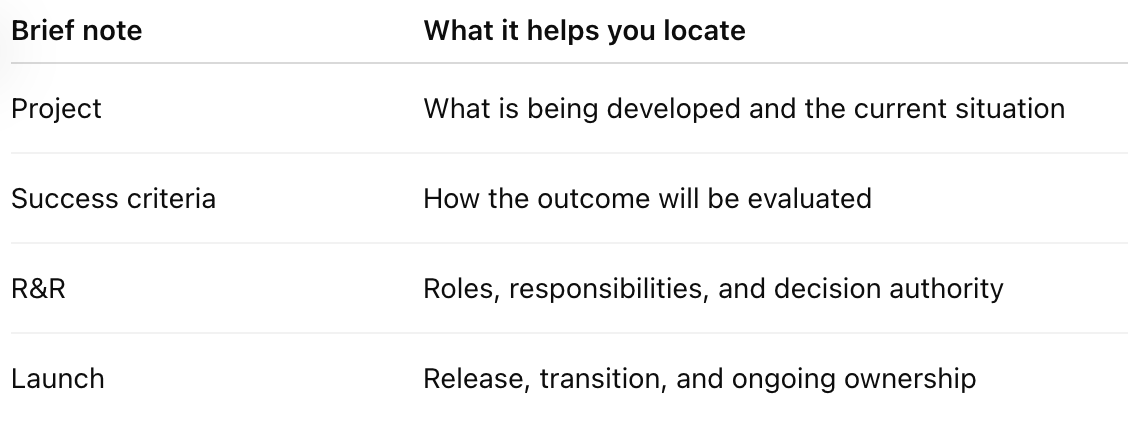
These labels are enough. You do not need to rewrite the case.
Another passage may need different labels, such as approach, schedule issue, change approval, and handover. Follow the information actually provided.
Use your own abbreviations during practice. The purpose is to help you return to the right section quickly.
4. Highlight specific facts that may affect a decision
Highlight selectively. Useful phrases establish a constraint, condition, or piece of evidence:
- “Funding supports four more experiments.”
- “The sponsor approves changes to investment limits.”
- “The impact analysis is complete.”
- “The deliverable has not met acceptance criteria.”
- “The receiving team will own ongoing operations.”
A specific funding limit may affect prioritisation. An approval requirement may affect the next action. A completed analysis may mean that further analysis is unnecessary. You may not use every highlight. That is fine. Highlighting makes important facts easier to locate; it does not require you to memorise them. Practise using the highlighting and option-elimination features available in your practice environment so that operating them does not interrupt your thinking.
5. Filter out industry detail that does not affect the decision
An unfamiliar industry can make a case appear more difficult than it is. A passage about a digital subscription service may describe readers, editors, registration, and retention. Translate that into familiar project management ideas:
- What outcome represents success?
- Who prioritises the work?
- What limits the available funding?
- Who approves investment changes?
- Who takes ownership after launch?
Give less attention to background detail that does not affect these decisions. Retain technical or industry information when it establishes a relevant requirement, risk, dependency, or constraint. You can defer understanding a detail until a question requires it. Deferring a detail does not mean deciding that it can never matter.
6. Answer each question using the evidence and your knowledge
Once you have the case structure, read the first question carefully.
Ask yourself:
“What decision is being tested, and do I have enough information to make it?”
Use your project management knowledge, mindset, and the facts provided. Read every option and compare what each one actually proposes.
For example, a case may define success as retaining paying customers. A related question then compares two experiments: one attracts more registrations, while another produces stronger retention.
The relevant decision is about alignment with the agreed success criteria. You may remember that criterion from your initial reading. If you do not, return to the “success criteria” section and check it.
Do not assume that more analysis is always the answer. If sufficient evidence is already available, the appropriate action may be prioritisation, approval, implementation, verification, or escalation.
Similarly, avoid eliminating an option because of one word alone. Understand the complete action and whether it fits the situation.
7. Return to the case with a specific purpose
Before looking back, identify what you need:
- A particular person’s authority?
- The approved measure of success?
- A funding limit?
- The status of an approval?
- A handover condition?
Then use your passage map to find it. This is more efficient than repeatedly rereading the whole case because you feel uncertain.
Some questions may provide enough information to answer without another reading. That does not automatically mean you have missed something. Check that your choice fits the known context, then move ahead.
How much time should you spend?
My suggested practice target is:
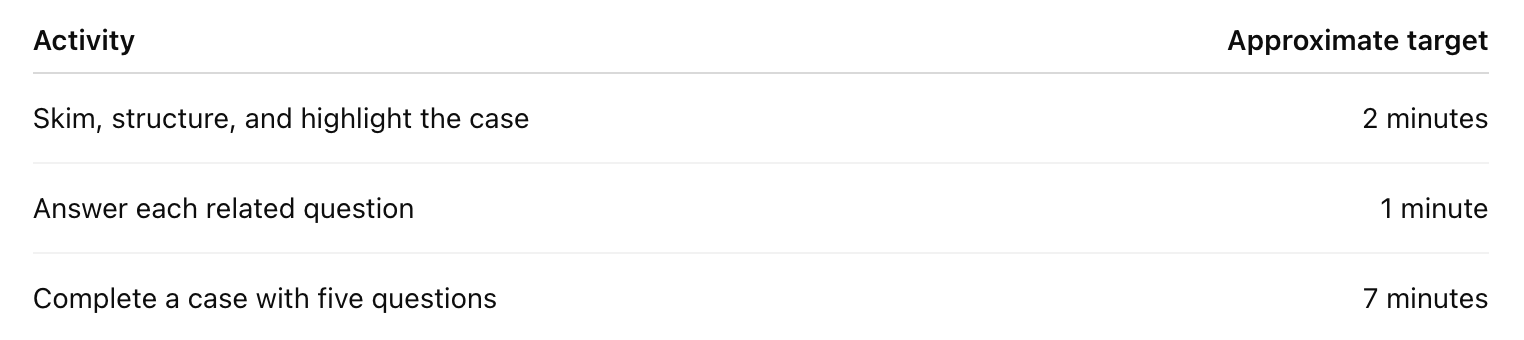
These are coaching targets, not official time limits.
If you repeatedly spend five minutes studying the passage, check whether you are trying to understand or remember more detail than you need. Shorten your notes and focus on recognising the information categories.
Maintain accuracy as you improve your pace. The question and options still require careful reading.
Can you read the questions first?
Yes! Some participants find that approach effective. One participant reported strong results after starting directly with the questions and returning to the passage when needed. My preferred starting point remains case first, structure first. It gives you context and can reduce the uncertainty of wondering whether an unseen case detail changes your answer.
However, test your strategy during practice. Use different, previously unseen cases and compare:
- Accuracy.
- Total time.
- Confidence.
- Missed case facts.
- Repeated reading.
Start with 20–30 questions, then validate the approach across more cases. One successful set is encouraging, but it does not establish that the method works consistently.
Choose your approach through practice before exam day.
Key takeaways
- Build a simple mental picture and a map of the case.
- Use short labels rather than detailed notes.
- Highlight facts that establish evidence, constraints, or authority.
- Read each question and every option carefully.
- Return to the relevant section when specific information is needed.
- Test your strategy across several unfamiliar cases.
Quick quiz
You have skimmed a case and noted four sections: project, success criteria, roles, and launch. A question asks who can approve an increase to the investment limit, but you do not remember the exact authority stated. What should you do?
- Choose the sponsor because sponsors usually control project funding.
- Reread the whole passage to rebuild your understanding of the project.
- Return to the roles section and check the stated approval authority.
- Choose the project manager because the request affects project delivery.
Answer: Return to the roles section and check the stated approval authority.
Your passage map helps you locate the required fact. Check the authority stated in this case rather than relying on a general assumption.
Frequently Asked Questions
Do I need a complete understanding of every case detail?
No. Develop enough understanding to recognise the situation and locate relevant information. Examine specific details when a question requires them.
How many phrases should I highlight?
There is no fixed number. Highlight selectively so that important facts remain easy to find.
What percentage of questions can be answered without returning to the case?
Do not plan around a fixed percentage. Participants’ experiences differ, and each question may require different evidence.
What if I cannot meet the two-minute reading target yet?
Review your reading process. Reduce detailed notes, practise identifying the passage structure, and gradually introduce timing.
Should I change strategies if one case goes badly?
Review why it went badly first. A knowledge gap, missed fact, or unusually difficult case may explain the result. Look for a pattern across several attempts.
Try the method on your next case
Select one complete case on your Edzest practice platform. Give yourself approximately two minutes to skim it, write a few structural labels, and highlight important facts. Then answer the related questions carefully. Review your time and reasoning. Identify which questions required the passage and whether your notes helped you find the evidence.
Skim the case. Structure the information. Read the questions carefully. Practise until the method feels familiar.