How to Study for PMP Exam
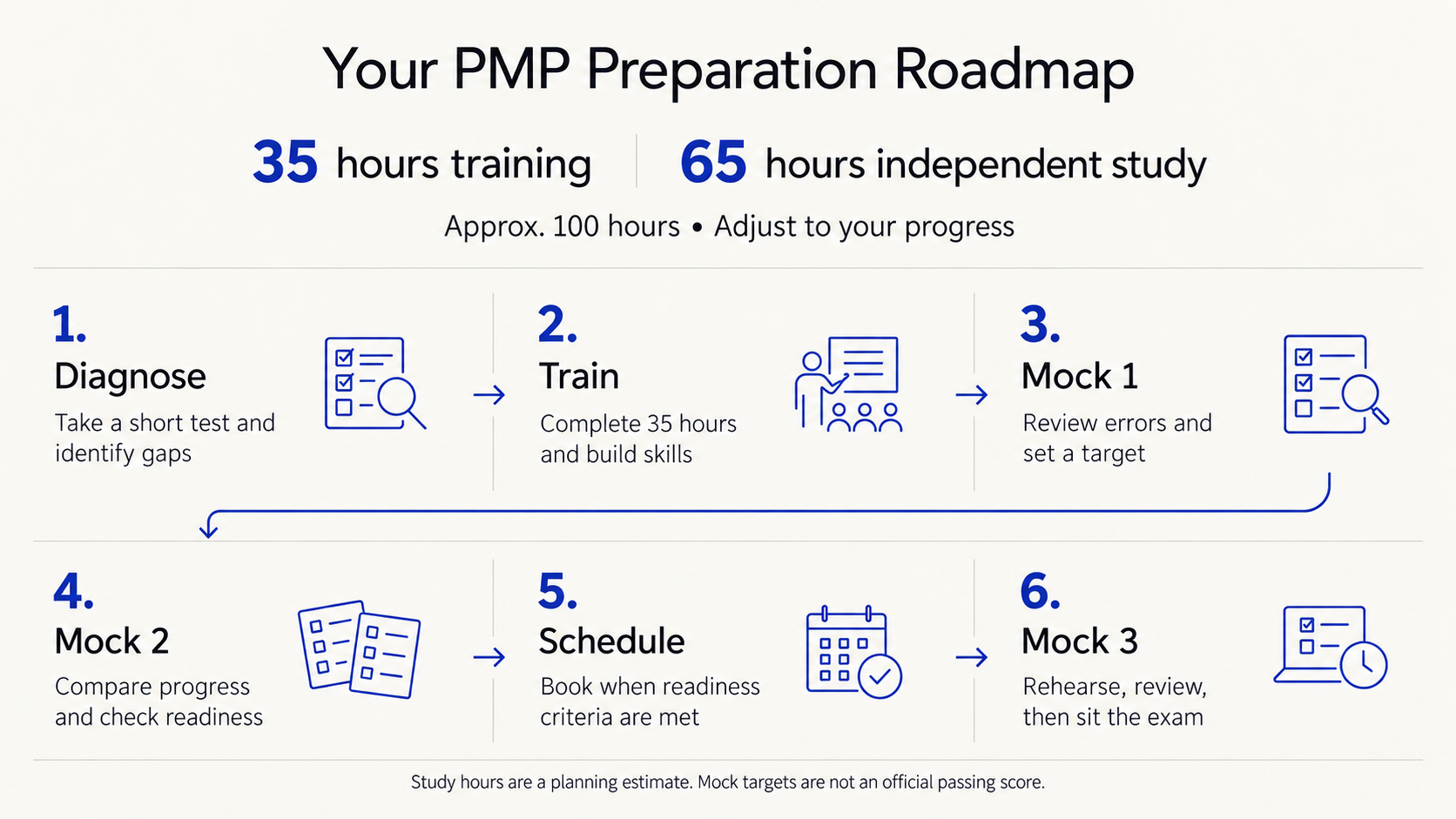
Set aside 100 hours of study: 35 hours for training and 65 hours of self-study that includes full mock exams practice and review.
By Amit Chandan, PMI-ATP instructor. 16 min read. Published 14 Oct 2026. Last updated 14 Oct 2026.
Preparing for the PMP exam becomes easier when you know what to study, how to use your time, and how to judge your progress. Buying several books, watching videos, and answering hundreds of questions may keep you busy, but a good preparation plan connects those activities to the skills you need to develop in order to pass the exam with confidence.
In this article, I have discussed a practical approach that has three stages:
- understand your starting point and create a study schedule,
- complete a training program while building the necessary skills, and
- use full mock exams to assess your readiness and schedule the actual exam.
As a general planning estimate, set aside approximately 100 hours: 35 hours of training and 65 hours of independent preparation. This is a suggested study budget, not a PMI requirement or a guarantee of readiness. Your diagnostic results and progress will show if you need more time or less.
Understand Your Starting Point and Create a Realistic Study Schedule
Start with the Exam Content Outline
Before choosing a book or beginning a course, become familiar with the PMP Examination Content Outline, or ECO. It is PMI’s authoritative blueprint for what the exam assesses.
The 2026 ECO contains 26 tasks across three domains: eight in People, ten in Process, and eight in Business Environment. Their exam weightings are 33%, 41%, and 26%, respectively. Predictive, adaptive, and hybrid approaches appear across the domains.
The ECO should become your preparation checklist. As you study, ask yourself whether you can explain each task, recognise it in a project situation, and make appropriate decisions about it.
You do not need to memorise every line before starting your training. Read it once to understand the scope, then return to it regularly to check your coverage.
The ECO defines the exam content. Other official PMI documents, including the Certification Handbook and exam preparation pages, explain matters such as eligibility, applications, and exam procedures.
Take a Diagnostic Before You Begin Studying
A short diagnostic or sample exam helps you understand your current base. Take it before extensive preparation so that the results reflect what you already know.
For a busy working professional, a diagnostic of around 30 questions completed in approximately 40 minutes can be a useful starting point. It should include varied situations rather than testing only definitions.
Attempt it without notes, explanations, or AI assistance. Record questions where you guessed or felt unsure, even if your answer turns out to be correct.
The purpose is to identify how you currently think through project situations. A low score at this stage is useful information: it helps you decide where your study time should go.
Look Beyond Your Overall Score
Two candidates can receive the same diagnostic score and need very different preparation plans.
One may understand project management but struggle to interpret long questions. Another may read accurately but lack familiarity with adaptive delivery. A third may choose actions that work in their organisation without checking whether those actions fit the scenario.
Review your baseline across these areas:
| Area | What to look for |
|---|---|
| Project management knowledge | Which concepts, practices, or terms are unfamiliar? |
| Applied thinking | Can you identify the problem, interpret the evidence, and evaluate competing actions? |
| Project management mindset | Do your decisions show ownership, proactive thinking, collaboration, and attention to value? |
| Question comprehension | Do you notice words such as “first,” “next,” “before,” and “except”? |
| Exam discipline | Do you read every option, avoid unsupported assumptions, and manage your time? |
For each incorrect or uncertain answer, write down the reason. “I need to study risk management” is less useful than “I confused a possible future risk with an issue that has already occurred.”
A specific diagnosis leads to a specific improvement activity.
Two learners score 60% on a diagnostic: one lacks conceptual knowledge, while the other repeatedly misreads questions; should they follow the same study plan?
They need different priorities: the first needs concept learning and application, while the second needs comprehension and question discipline alongside targeted revision.
Build Your Schedule Around Available Hours
Start with the time you can consistently protect each week. Consider your work commitments, family responsibilities, travel, and energy levels.
If you can study for ten hours per week, a 100-hour plan takes approximately ten weeks. At twelve to thirteen hours per week, it takes around eight weeks. These estimates include training time.
For an eight-week plan, you might allocate your hours as follows:
| Activity | Suggested hours |
|---|---|
| Diagnostic, review, and study planning | 3 |
| Training program | 35 |
| Concept revision and targeted reading | 25 |
| Topic practice and explanation review | 15 |
| Three full mock exams | 12 |
| Detailed mock review and corrective study | 8 |
| Final revision | 2 |
| Total | 100 |
The independent preparation activities total 65 hours. If reviewing questions takes longer, extend the plan rather than cutting the review short.
Reading an explanation, understanding why you made a mistake, and applying that learning to another situation are all study activities. Count them in your schedule.
Use an Eight-Week Plan as a Starting Template
The following example assumes that your 35-hour training program runs over four weeks. Adjust it to match your course schedule.
| Week | Training | Independent study | Main focus |
|---|---|---|---|
| 1 | 5 hours | 5 hours | Read the ECO, take the diagnostic, and begin training |
| 2 | 10 hours | 5 hours | Revise lessons and practise recently covered topics |
| 3 | 10 hours | 5 hours | Strengthen understanding and resolve recurring doubts |
| 4 | 10 hours | 5 hours | Complete training and check coverage of all 26 tasks |
| 5 | — | 15 hours | Take the first full mock, review it, and set improvement targets |
| 6 | — | 10 hours | Address gaps, take the second mock, and assess readiness |
| 7 | — | 10 hours | Schedule the exam when ready and continue focused preparation |
| 8 | — | 10 hours | Take the third mock before exam day and complete final revision |
| Total | 35 hours | 65 hours | 100 hours |
During the training weeks, a manageable independent routine could be four 45-minute sessions and one two-hour weekend session. Later, reserve uninterrupted blocks for full mock exams.
Make each study session specific. Instead of writing “study procurement,” write “review contract selection, answer ten procurement questions, and explain the mistakes.”
Complete Your Training and Build the Skills the Exam Requires
Complete the Required 35 Contact Hours
For candidates who need to satisfy the training requirement, PMI requires 35 hours of eligible project management education or training. Keep your completion documentation for the application process. The training requirement sits alongside PMI’s education and professional experience requirements.
The 35 hours should be a substantial learning experience. Attend actively, ask questions, attempt exercises, and connect the lessons to situations you have encountered at work.
Completing the course gives you a foundation. Your independent preparation then strengthens your ability to apply that foundation under exam conditions.
Choose a Training Program You Can Trust
PMI Authorized Training Partner training is a strong, trusted starting point for PMP preparation. ATP courses use PMI-developed learning materials, and PMI states that their PMP preparation training aligns with exam content and satisfies the 35-hour requirement.
However, examine the learning experience as well as the provider’s status. Before enrolling, ask:
- Is the course aligned with the current ECO?
- Will the trainer explain the reasoning behind project decisions?
- Can you clarify doubts during and after training?
- Are practice questions and full mock exams included?
- Do the mocks include useful explanations and performance analysis?
- How long will you retain access to the materials?
Verify ATP status through PMI’s directory. Also confirm exactly what the institute provides; mock exams and post-course support can vary between programs.
Timing matters when selecting live training. PMI has announced that, from 1 December 2026, eligible live training must come through an ATP, a China Registered Education Provider, or an eligible accredited academic program. Training completed before that date remains eligible under the current rules.
Consider Self-Paced Courses If You Need Flexibility
A self-paced course can suit professionals whose work schedules make regular classes difficult. PMI offers an official on-demand PMP preparation course that fulfils the 35-hour training requirement. Other eligible self-paced options are also available.
Before choosing one, check its alignment with the current exam, completion documentation, practice resources, and doubt-resolution support.
The main challenge is maintaining momentum. Reserve course sessions in your calendar and complete the associated exercises. Watching a lesson while distracted may count as time spent, but it gives you little evidence that you understood the content.
Build Knowledge, Thinking Skills, and Exam Skills Together
During training, develop three connected capabilities.
First, build conceptual understanding. Learn what a practice means, why it is used, and how it connects to other project activities. For example, understanding change control includes recognising when a change needs evaluation, who has authority to approve it, and what happens after approval.
Second, build applied thinking. Learn to identify relevant evidence, distinguish symptoms from causes, recognise constraints, and evaluate trade-offs. A suitable action depends on the situation, the delivery approach, and what has already happened.
Third, build exam discipline. Practise reading the complete question and every option. Notice whether the question asks for an immediate action, a next step, or something that must happen before a commitment.
Avoid turning useful principles into rigid shortcuts. “Assess first” may be appropriate when information is missing. If the scenario says that assessment is complete and approval has been obtained, implementation may be the appropriate next step.
Similarly, collaboration is valuable, but some situations require escalation, formal approval, or urgent action. Your answer should follow the evidence in the question.
Use the PMBOK® Guide—Eighth Edition to Deepen Understanding
The PMBOK Guide—Eighth Edition is a valuable official resource for understanding project management principles and practice. PMI presents it as a project management standard with practical guidance across different approaches and environments.
It is not a dedicated PMP exam preparation textbook. Reading it from beginning to end does not, by itself, provide a complete exam preparation process.
Use it purposefully. When training or a practice question reveals a gap, read the relevant section, connect it to the ECO task, and then practise applying the concept.
For example, if you struggle to distinguish a deliverable from a benefit, use the guide to strengthen that understanding before answering more questions about value and outcomes.
You do not need to collect every available reference. A focused set of resources that you use thoroughly is easier to manage:
- The current ECO as your coverage checklist.
- A structured training course as your main learning path.
- Relevant official references for deeper understanding.
- A reliable question bank and full mocks for practice and assessment.
Use AI to Clarify Doubts Carefully
AI can help explain unfamiliar concepts in simple language, provide examples, compare related terms, and organise your revision.
Useful requests include:
“Explain the difference between a risk and an issue using one project example.”
“Help me understand how change decisions differ in predictive and adaptive projects.”
“Ask me questions that check whether I understand stakeholder engagement.”
Be more cautious when asking AI to solve practice questions. It can overlook a condition, introduce an assumption, or produce a convincing explanation for an incorrect answer. It may also change its answer simply because you challenge it.
Attempt the question independently first. Then review the question bank’s explanation. If you still have a doubt, use AI to explore the concept and verify the reasoning with your trainer or a trusted source.
When using AI to discuss a question, ask it to identify the evidence supporting each option and any assumptions it is making. This encourages a more useful discussion than asking only for the correct letter.
Keep AI assistance outside diagnostic and mock exam attempts so that the results measure your own readiness.
Use Full Mock Exams to Measure Progress and Schedule Your Exam
Take the First Full Mock After Training
Once you have completed training and an initial revision of the syllabus, take a full mock exam. You do not need to feel completely ready beforehand; this attempt will show you what still needs work.
A full mock tests your endurance, concentration, pacing, and ability to make decisions across unfamiliar situations.
Choose a simulator aligned with the current exam. The 2026 ECO specifies 180 questions, 240 minutes of answering time, and two ten-minute breaks. It also describes case-based, graphic-based, multiple-response, and matching formats. Practise the available formats and section restrictions as closely as your simulator allows.
Take the mock without notes, AI, or unscheduled interruptions. Plan for the full sitting, including breaks.
Review the Attempt Before Taking Another
Your score tells you where you stand. Reviewing the attempt tells you what to change.
Review incorrect answers, guessed answers, and correct answers where your reasoning was uncertain. Classify each problem:
| Problem | Appropriate improvement |
|---|---|
| The concept was unfamiliar | Revisit the lesson and practise the concept |
| A condition in the question was missed | Practise careful reading and identifying constraints |
| Two options seemed equally suitable | Compare their timing, authority, and fit with the evidence |
| An assumption influenced the answer | Identify what the scenario actually states |
| Time pressure caused rushed decisions | Adjust pacing and review habits |
| Performance dropped late in the exam | Work on endurance, breaks, and concentration |
Maintain a short error log. Record the lesson you need to remember rather than copying lengthy explanations.
For example: “Before choosing escalation, check whether the project manager has the authority and information to resolve the issue.”
Set a Target Score for Your Practice System
After the first mock, agree on a readiness target with your trainer or use the simulator’s documented guidance.
A mock target is a preparation benchmark, not an official PMP passing percentage. PMI determines passing standards through psychometric analysis; do not treat a practice score as a guaranteed exam outcome.
For illustration, a trainer might recommend a target of 75% on a particular simulator. That target belongs to that simulator and its difficulty level. It should not automatically be applied to another question bank.
Include other conditions in your target: completing within time, avoiding major topic gaps, maintaining concentration, and being able to explain your decisions.
Take a Second Full Mock and Compare the Evidence
After targeted study, take a second full mock using unseen questions of comparable difficulty.
Compare more than the overall percentage:
- Have the weak areas improved?
- Are comprehension mistakes less frequent?
- Are you guessing less often?
- Are you finishing within time?
- Is your performance steadier across the sitting?
An increase from 62% to 76%, for example, is encouraging only when the exams are reasonably comparable. Repeating familiar questions can raise your score without demonstrating stronger decision-making.
If the second mock reveals persistent weaknesses, revise your plan. Add focused study time and reassess rather than booking solely because you have completed the planned hours.
Your score rises from 65% to 85% after repeating the same mock; is that enough evidence to schedule the exam?
Familiarity may explain part of the increase, so check your readiness using unseen questions under comparable conditions.
Schedule the Exam When Your Results Support It
When the second mock meets your agreed readiness criteria, schedule the PMP exam, subject to application approval and appointment availability.
Check eligibility early and work on the application during preparation. This allows the application process and study progress to move forward together.
Choose an exam date that leaves enough time to review the second mock, resolve remaining gaps, and take one more full mock. You do not need to wait until you feel certain about every possible question. Look for consistent evidence that you can handle unfamiliar scenarios independently.
Take a Third Full Mock Before Exam Day
Take the third mock between booking and the actual exam, ideally with enough time remaining to review it without rushing.
Its purpose is to confirm readiness and rehearse your exam routine. Check whether you can maintain your pace, use breaks effectively, recover after difficult questions, and stay focused through the final section.
If a weakness remains, address it specifically. Avoid responding to one disappointing result by buying several new resources or taking repeated mocks without review.
During the final days, use your error log, revisit important doubts, review your pacing plan, and confirm the exam arrangements.
Is PMI Study Hall Necessary?
PMI Study Hall can be a helpful additional practice resource, but purchasing it is not a certification requirement.PMI includes it among its preparation options.
Check what your training institute already provides before purchasing another question bank. If you have current, well-designed mocks with detailed explanations and useful performance feedback, you may already have the practice resources you need.
Study Hall may be useful when you want additional official practice or more unseen questions. Choose it because it fills a gap in your preparation.
The value comes from how you use your practice resources: attempt independently, review your reasoning, correct the underlying weakness, and check whether the improvement carries into the next exam.
Frequently Asked Questions
How long should I study for the PMP exam while working full-time?
Start with a planning budget of approximately 100 hours, including 35 hours of training and 65 hours of independent study, and adjust it based on your diagnostic results and progress.
Are the 35 training hours enough to prepare for the PMP exam?
The 35 hours provide a foundation, but you should also practise applying concepts, review mistakes, and take full mock exams to assess your readiness.
Do I need to read the entire PMBOK® Guide to pass the PMP exam?
You do not need to read it cover to cover; use it as a reference to clarify concepts while following a structured preparation plan aligned with the current ECO.
Is PMI Study Hall necessary if my training institute provides mock exams?
Study Hall is optional and can provide additional practice, but first assess whether your institute’s current, exam-aligned mocks offer sufficient coverage, explanations, and performance feedback.
What mock exam score means I am ready to schedule the PMP exam?
Use your simulator’s readiness guidance alongside consistent performance on unseen questions, sound reasoning, and effective time management, because no mock percentage guarantees a pass.
Test your current knowledge here